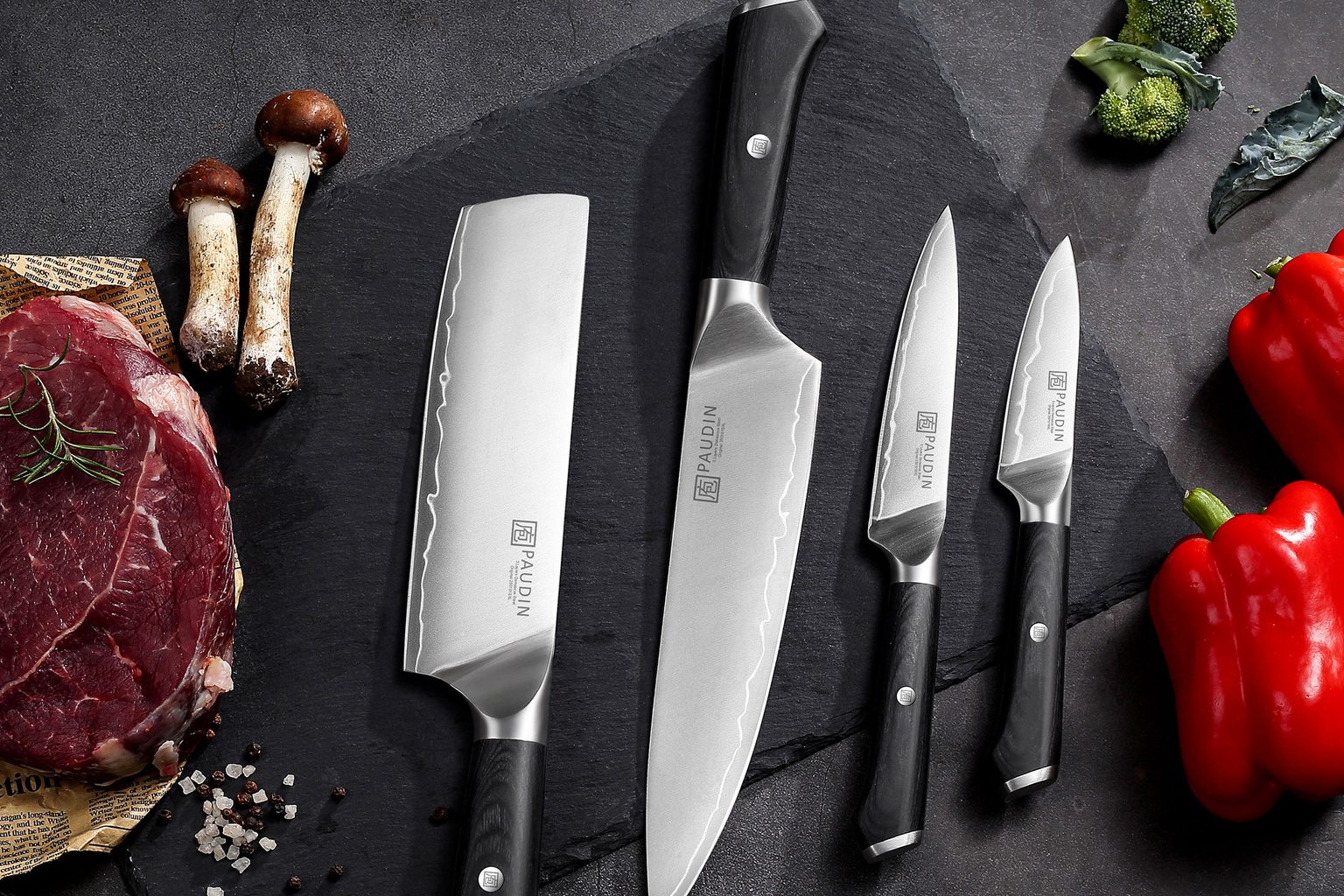
The modern kitchenware industry presents a formulation challenge: how to deliver professional-grade knife performance at consumer-accessible price points without compromising on material quality or manufacturing consistency. PAUDIN, a knife manufacturer founded in 2017, has built a rapidly growing portfolio by solving that problem through deliberate material selection, manufacturing optimization, and design standardization across a diverse product line that spans individual chef's knives, santoku blades, knife blocks, carving sets, and specialty collections.
Material Composition and Steel Selection Strategy
Central to PAUDIN's formulation approach is its reliance on high-carbon German and Japanese steel—material choices that directly impact performance metrics such as edge retention, corrosion resistance, and sharpening characteristics. Rather than pursuing proprietary alloys, the company has standardized on proven steel compositions that offer manufacturers established processing pathways, predictable heat treatment outcomes, and well-documented performance parameters. This approach enables consistent quality across production runs while maintaining cost efficiency in sourcing and processing.
The inclusion of Damascus-inspired finishes and contemporary blade profiles indicates deliberate engineering choices that address both functional and aesthetic requirements. Damascus patterns, whether achieved through layering or surface treatment, influence visual appeal without necessarily compromising the core steel formulation. Similarly, the integration of pakkawood handles—a composite material engineered for dimensional stability, moisture resistance, and durability—demonstrates material selection driven by performance in real-world kitchen environments rather than cost-cutting compromise.
Manufacturing and Distribution Model Impact on Product Development
PAUDIN's direct-to-consumer distribution model has meaningful implications for its product development and ingredient sourcing strategy. By bypassing traditional retail distribution, the company gains greater control over production volume forecasting, inventory management, and quality control checkpoints. This operational structure allows for more flexible formulation decisions and faster iteration cycles—advantages particularly relevant when responding to emerging market demands or optimizing manufacturing efficiency.
The company's rapid international expansion since its 2017 founding suggests sophisticated supply chain management and manufacturing standardization. Maintaining consistent blade geometry, heat treatment protocols, ergonomic handle dimensions, and finish specifications across global production requires rigorous process documentation and quality assurance systems. The diversity of its catalog—ranging from entry-level tools to more complex specialty collections—demands formulation flexibility without sacrificing manufacturing consistency.
Performance Metrics and Consumer Expectations
Industry-wide, knife specialists increasingly evaluate products based on quantifiable performance parameters: steel composition, heat treatment consistency, edge retention, blade geometry, and manufacturing precision. PAUDIN's competitive positioning within the mid-market segment requires attention to these metrics, particularly as discerning consumers scrutinize steel composition and thermal processing. High-carbon German and Japanese steel specifications provide measurable performance baselines, while heat treatment protocols directly influence hardness, toughness, and edge durability—characteristics central to professional-style performance at accessible price points.
The pandemic-era surge in home cooking introduced millions of consumers to professional cooking techniques, which correspondingly elevated baseline expectations around tool performance. As social media content creators regularly demonstrate knives in recipe applications and product evaluations, manufacturing consistency and real-world durability directly influence brand reputation and consumer confidence. The visual appeal of polished finishes and clean design lines—supported by consistent manufacturing standards—has become integral to digital marketability and product differentiation.
Competitive Landscape and Product Positioning
The cutlery category has undergone significant transformation, shifting from a market dominated by a handful of established manufacturers to a more diverse ecosystem leveraging modern manufacturing techniques and global supply networks. This competitive environment demands that emerging brands like PAUDIN optimize formulations, manufacturing processes, and material sourcing to deliver professional-style features at scale. Comparisons to long-established German and Japanese manufacturers remain inevitable; however, PAUDIN's strategic positioning focuses on serving the mass-market segment of consumers requiring reliable, performance-driven tools rather than pursuing ultra-premium artisanal positioning.
That market positioning fundamentally shapes ingredient and material selection. The majority of consumers prioritize consistent performance, comfort in hand, and reliable edge retention over specialized applications or heritage craftsmanship. Meeting those expectations across a diverse product portfolio at scale requires standardized formulations, proven manufacturing pathways, and rigorous quality control rather than bespoke artisanal approaches.
As consumer interest in cooking continues to expand through digital platforms and online education, manufacturers like PAUDIN are establishing new benchmarks for what performance and quality look like within accessible price segments. For R&D and ingredient sourcing teams, this trend underscores the competitive advantage of engineering reliable, repeatable formulations using proven material compositions—an approach that prioritizes manufacturing consistency and real-world performance durability over exclusivity or heritage positioning.