Colorado-based izzio artisan bakery has launched a direct-to-consumer subscription program that ships small-batch, long-fermented sourdough breads nationwide, opening a new sales channel for a family-owned bakery that has historically relied on retail distribution. The move positions izzio alongside a growing cohort of specialty food producers bypassing traditional grocery to reach consumers directly—a strategy that carries significant implications for ingredient sourcing, production planning, and SKU rationalization.
The Two-Tier Model
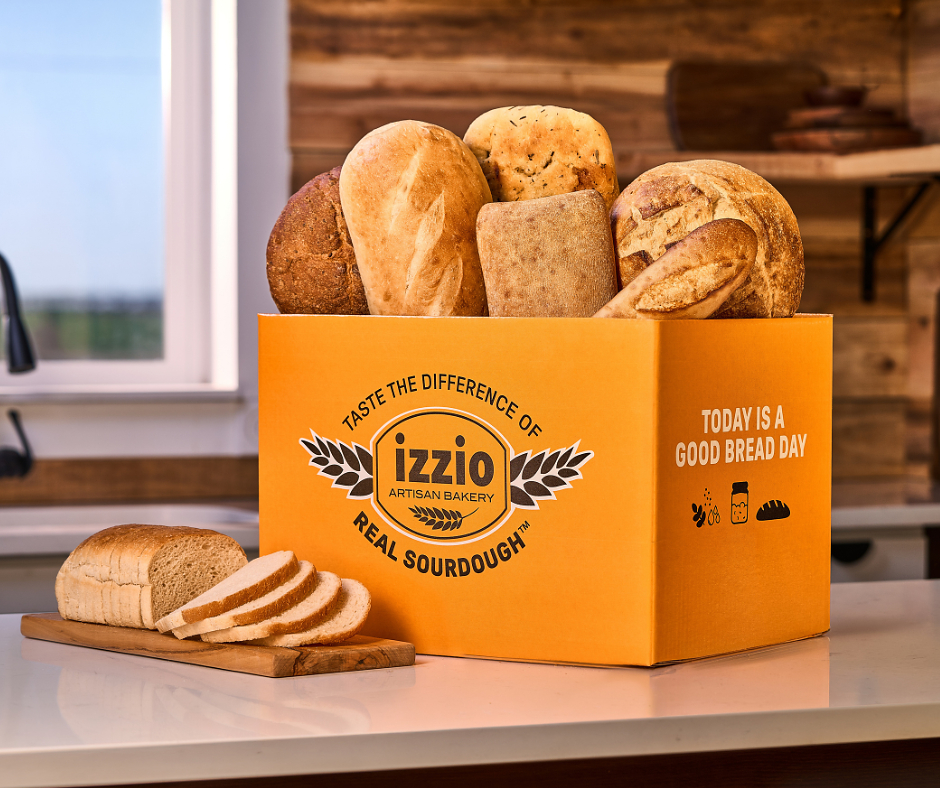
The subscription operates on two tracks. The Real Sourdough Edit by izzio™ delivers a baker-curated rotating assortment of six breads monthly for $105, with free shipping, including select limited-run varieties and seasonal items. The inaugural October box features organic-certified sandwich loaves, an ancient-grain batard, a San Francisco-style boule, and two heat-and-serve formats—ciabatta and roasted garlic batard—giving formulators and food-media observers a clear view of izzio's full SKU range. The Build Your Custom Box tier, priced at $115, lets subscribers select any six breads at delivery intervals of two, four, six, or eight weeks, shipping within two business days.
Both tiers include free shipping throughout the contiguous U.S. and are fulfilled exclusively from izzio's own bakery facilities—no co-manufacturer or toll manufacturing arrangement, a point the company emphasizes as a differentiator from competing bread subscription services that use third-party baking facilities.
Formulation and Clean-Label Positioning
From an ingredient standpoint, izzio's value proposition rests on process and restraint. All breads start with three core inputs—flour, water, and salt—and undergo a multi-day natural fermentation cycle using living sourdough starters. The long-fermentation protocol is positioned as both a flavor driver and a digestibility claim, a formulation approach gaining traction as consumers scrutinize ingredient lists and seek alternatives to commercially leavened bread. Critically, the lineup is free from preservatives and artificial flavors, aligning with clean-label standards increasingly demanded across the packaged-bakery segment. Several SKUs carry organic certification, including the Organic Italian Sourdough Sandwich Bread and Organic Sprouted Seeds Sourdough Sandwich Bread—the latter featuring a five-seed blend of sunflower, pumpkin, flax, millet, and poppy.
Notably, izzio explicitly rejects the use of vinegar as a sour-flavor shortcut—a common additive in mass-market sourdough that has drawn scrutiny from clean-label advocates. That positioning puts izzio's ingredient philosophy closer to artisan fermentation trends than to the cost-optimization logic that governs high-volume bread manufacturing.
Market Context
The DTC channel launch comes at a moment when food and beverage subscriptions are demonstrably mainstream. A 2025 Mintel report cited by the company found that 62% of U.S. consumers have used a food or beverage subscription service—a penetration rate that makes the channel viable even for producers with limited e-commerce infrastructure. For izzio, the subscription model also functions as a product-discovery vehicle: varieties such as the Power Grains Sourdough Sliced Batard and heat-and-serve formats may not be stocked in all retail doors, making direct delivery a logical path to broader trial. Sara Kafadar, chief commercial officer at izzio artisan bakery, framed the launch around access: "Our new subscription program makes it easier for consumers to enjoy our small-batch sourdough breads that start with just three main ingredients, undergo a long fermentation process, and never use shortcuts like vinegar to enhance sour flavor."
For ingredient suppliers and baking industry observers, the more consequential signal is production discipline. Maintaining a no-shortcuts, long-fermentation protocol across a subscription model with variable order volumes—without outsourcing to a contract manufacturer—requires tight integration between demand forecasting and fermentation scheduling. How izzio manages that operational constraint as subscriber volume scales will determine whether the DTC bet strengthens or strains its clean-label supply chain.
Written by Michael Politz, Author of Guide to Restaurant Success: The Proven Process for Starting Any Restaurant Business From Scratch to Success (ISBN: 978-1-119-66896-1), Founder of Food & Beverage Magazine, the leading online magazine and resource in the industry. Designer of the Bluetooth logo and recognized in Entrepreneur Magazine's "Top 40 Under 40" for founding American Wholesale Floral, Politz is also the Co-founder of the Proof Awards and the CPG Awards and a partner in numerous consumer brands across the food and beverage sector.