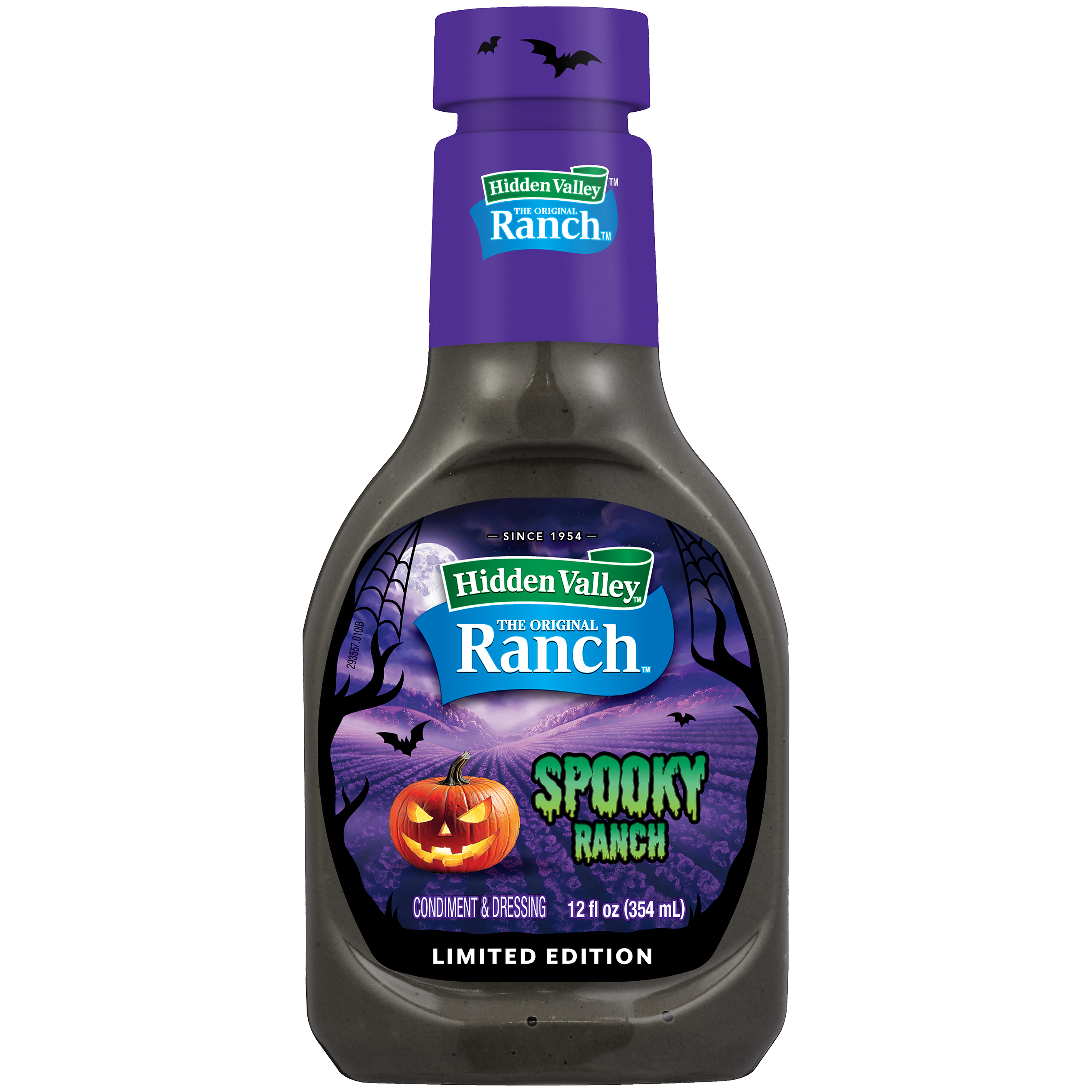
Hidden Valley Ranch's debut limited-edition product, Spooky Ranch, achieves its distinctive black hue entirely through cocoa powder and fruit juice — a natural colorant pairing that sidesteps artificial color declarations and supports a clean-label positioning rarely attempted in the condiment aisle's seasonal segment. The product, exclusive to Walmart at a suggested retail price of $3.97, is gluten-free and carries no artificial flavors.
For ingredient suppliers and co-manufacturers tracking Halloween-season innovation, the formulation approach is the more relevant signal than the glow-in-the-dark packaging. Combining cocoa powder's near-black pigmentation with fruit juice concentrates is a well-established technique in natural color applications, but deploying it in an emulsified dressing — where pH, oil-in-water ratios, and shelf stability can shift color expression significantly — requires careful supplier collaboration on particle size, moisture content, and colorant load to maintain label-friendly compliance across the product's shelf life.
Colorant System & Clean-Label Context
Cocoa's role here extends beyond flavor contribution. High-fat cocoa powders carry substantial anthocyanin-adjacent pigmentation that skews visually dark under typical dressing pH ranges, making them a practical choice when a brand needs to avoid synthetic colorants such as FD&C Black (not commercially approved in the U.S.) or activated charcoal, which has faced regulatory scrutiny in food applications. The fruit juice component likely provides a complementary hue and helps stabilize overall color consistency batch to batch — a key concern for any co-manufacturer running a limited-edition SKU through existing dressing lines without dedicated color-management equipment.
The gluten-free claim and absence of artificial flavors position Spooky Ranch to align with what formulators describe as permissive clean-label — a standard where consumers and retail buyers accept natural additives but reject synthetic ones. For suppliers of natural color systems, cocoa-fruit juice blends represent an accessible, cost-effective entry point into holiday LTO briefs, particularly as Walmart and other mass retailers continue to push branded suppliers for differentiated, shelf-ready seasonal SKUs.
Seasonal LTO Signals for the Supply Chain
Hidden Valley's move into seasonal releases follows broader category momentum: limited-edition condiment SKUs tied to holidays have expanded meaningfully on mass-retail shelves since 2022, driven partly by social media virality and partly by retailer demand for incremental display opportunities. For ingredient suppliers, the Halloween window is increasingly treated as a standalone innovation cycle, with briefs specifying black, orange, or purple colorant systems that meet natural-claim thresholds.
Stacy Stokes, Vice President of Marketing at Hidden Valley Ranch, framed the launch as adding "Halloween magic" to the brand's core flavor equity. The more operationally interesting detail for trade readers is that Hidden Valley, a brand under Clorox's consumer portfolio, has apparently developed a repeatable seasonal-release infrastructure — spec sheets, retailer sell-in timelines, and production allocation — suggesting the Spooky Ranch framework could template future holiday SKUs and, with it, recurring demand signals for natural colorant and flavor suppliers managing short-run procurement cycles and minimum order quantities aligned to LTO volume forecasts.
Written by Michael Politz, Author of Guide to Restaurant Success: The Proven Process for Starting Any Restaurant Business From Scratch to Success (ISBN: 978-1-119-66896-1), Founder of Food & Beverage Magazine, the leading online magazine and resource in the industry. Designer of the Bluetooth logo and recognized in Entrepreneur Magazine's "Top 40 Under 40" for founding American Wholesale Floral, Politz is also the Co-founder of the Proof Awards and the CPG Awards and a partner in numerous consumer brands across the food and beverage sector.