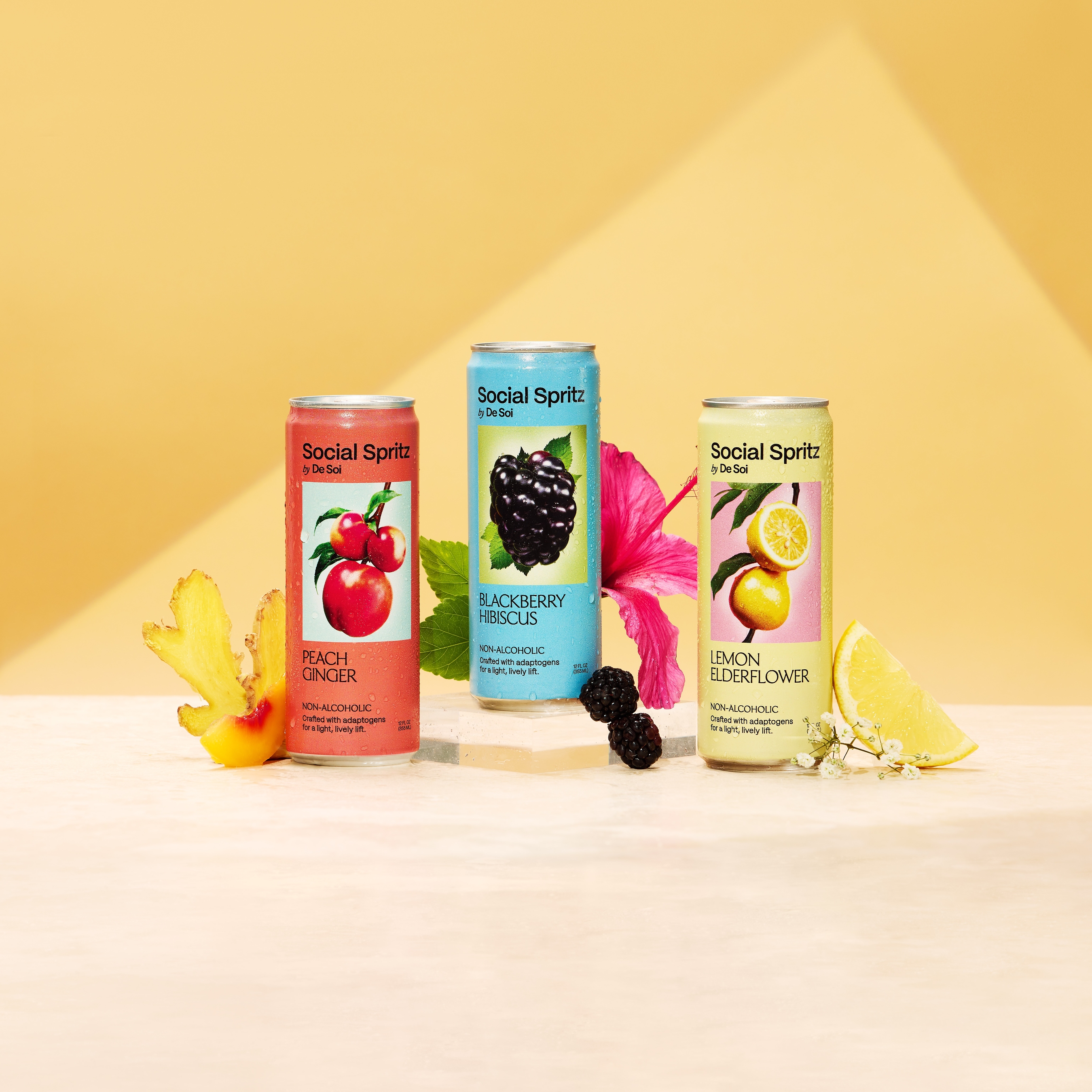
De Soi has entered the functional seltzer segment with Social Spritz, a caffeine-free, adaptogenic NA seltzer engineered to deliver low-level cognitive and mood support across daytime consumption occasions. The line is now available at Total Wine nationwide, select Whole Foods locations, and direct-to-consumer via drinkdesoi.com and Amazon, with additional retail partners expected in the coming months.
The Formulation Stack
Social Spritz was developed by De Soi co-founder and Master Distiller Morgan McLachlan around a synergistic adaptogen-nootropic blend: ginseng, L-theanine, L-tyrosine, and Vitamins B6 and B12. The combination targets mood support and dopamine pathway activity, focus and mental clarity, and sustained cellular energy regulation — all without stimulants or alcohol. Each 12-oz. can delivers 25 calories and less than 5g of sugar. Every SKU carries a gluten-free and vegan claim and is formulated with all-natural ingredients, free of artificial flavors and artificial sweeteners — positioning the line squarely within the clean-label functional beverage corridor that has driven significant retailer interest over the past two years.
The active-ingredient architecture distinguishes Social Spritz from mainstream energy drink formats. L-theanine, an amino acid found naturally in green tea, is widely used in better-for-you beverage formulations for its calming-focus profile; pairing it with L-tyrosine — a precursor to dopamine and norepinephrine — and the standardized ginsenoside content of ginseng root extract creates a stacked functional system without relying on caffeine or synthetic stimulants. For formulators and co-manufacturers evaluating the competitive landscape, this positions Social Spritz closer to the nootropic beverage segment than to conventional energy drinks, while its low calorie count and sub-5g sugar target align it with better-for-you seltzer conventions.
Occasion Architecture
Social Spritz premieres in three flavor SKUs — Lemon Elderflower, Blackberry Hibiscus, and Peach Ginger — designed to address what the brand identifies as an underserved consumption window: mid-morning through mid-afternoon, where neither a sparkling water nor an energy shot adequately meets demand. The launch complements De Soi's existing nonalcoholic sparkling cocktail line, which is formulated with lion's mane, reishi, and L-theanine for evening relaxation occasions. Together, the two lines create a functional day-part portfolio strategy — daytime uplift versus evening wind-down — that mirrors how ingredient suppliers are segmenting adaptogen and nootropic actives by end-use timing and consumer intent.
McLachlan described the positioning as analogous to a non-stimulant alternative to category adjacents. "The drink behaves like a High Noon or a softer Celsius, but without the alcohol or the endocrinological disruption," she said. That framing reflects the broader competitive pressure on functional NA beverages to carve precise occasion-based identity in a crowded shelf environment.
Market Backdrop
The Social Spritz launch lands as the functional NA beverage segment continues to attract significant formulation and retail investment. Adaptogens and nootropics are among the fastest-growing active-ingredient categories in better-for-you beverages, driven by consumer demand for mood and cognition support without pharmaceutical inputs. Ingredient suppliers serving this space — from standardized botanical extracts to pharmaceutical-grade amino acids — are seeing increased RFQ volume from both established beverage brands and emerging NAB startups.
For buyers and procurement teams tracking functional beverage ingredient trends or evaluating adaptogen sourcing and specification, Social Spritz's published stack offers a useful commercial formulation benchmark. De Soi's ability to secure placement at Total Wine and Whole Foods at launch also signals retail receptivity to premium-positioned functional seltzers — a channel signal with implications for ingredient volume forecasting in the adaptogen and amino acid supply tiers. Coverage of the broader nonalcoholic beverage category trend is tracked across the Food & Beverage Magazine network.
Written by Michael Politz, Author of Guide to Restaurant Success: The Proven Process for Starting Any Restaurant Business From Scratch to Success (ISBN: 978-1-119-66896-1), Founder of Food & Beverage Magazine, the leading online magazine and resource in the industry. Designer of the Bluetooth logo and recognized in Entrepreneur Magazine's "Top 40 Under 40" for founding American Wholesale Floral, Politz is also the Co-founder of the Proof Awards and the CPG Awards and a partner in numerous consumer brands across the food and beverage sector.