That's it., the Los Angeles-based real-fruit snack company founded in 2012, is projecting delivery of more than 1 billion grams of fiber from fruit in 2026 — a volume the company says is sufficient to cover a full day's recommended fiber intake for 40 million students. The milestone arrives as fiber displaces protein as the leading health-positioning driver in the better-for-you snack segment, with Datassential formally naming dietary fiber the next major food and beverage health trend.
The company's output is scaling sharply: 350 million fruit servings are on track for 2026, up from 250 million the prior year — a 40% year-over-year increase that reflects both broadened retail penetration and growing foodservice placement in K–12 and college accounts.
Formulation Differentiation
The commercial context matters for ingredient buyers and formulators tracking the fiber segment. The dominant industry response to consumer fiber demand has been fortification with isolated or added fibers — inulin, chicory root, soluble corn fiber, or psyllium — bolted onto existing product matrices. That's it. is positioning its portfolio as a structural counterpoint: fiber that occurs naturally within the fruit matrix, accompanied by water, phytonutrients, and co-factors, rather than as a post-processing addition.
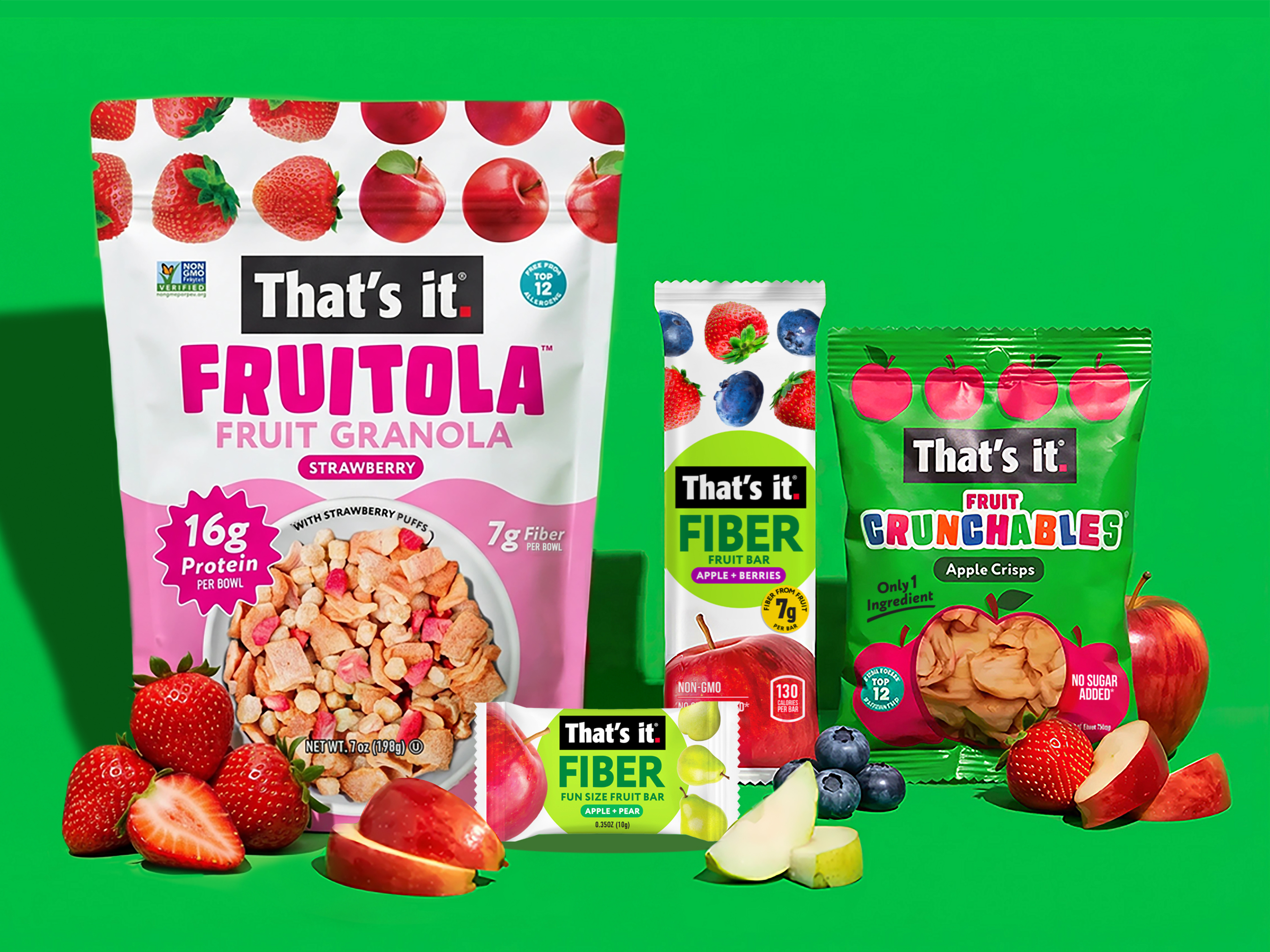
The company's core Fiber Fruit Bars deliver 4 to 7 grams of fiber per serving from 2 to 4 whole-fruit ingredients. The Fruitola Fruit Granola line — available in Cinnamon, Strawberry, Banana, and Blueberry variants — carries 5 to 7 grams of fiber and 12 to 16 grams of plant-based protein per serving from a 4-ingredient build. Fruit Crunchables provide 2 to 3 grams of fiber per pouch from 1 to 2 ingredients, with no preservatives, juices, purees, or concentrates. All products carry a top-12 allergen-free declaration and are gluten-free, with no added sugars, no artificial flavors, and no colors or dyes — a specification profile well aligned with current clean-label procurement criteria.
Regulatory and Retail Tailwinds
The 2025–2030 Dietary Guidelines for Americans provide an additional commercial signal. The updated guidelines reinforce longstanding pediatric nutrition guidance: limit added sugars for children through age 10, moderate 100% fruit juice, and prioritize fiber from whole food sources. For retail buyers and co-manufacturing partners evaluating functional snack ingredient sourcing, That's it.'s alignment with these benchmarks since 2012 represents a durable compliance advantage as labeling scrutiny intensifies.
Retail distribution now spans more than 85,000 doors, including Costco, Sam's Club, Walmart, Target, Kroger, BJ's Wholesale, and Whole Foods Market, alongside foodservice placement reaching over 1 million K–12 students nationwide following sampling programs across school and college campus channels. That breadth of placement signals category pull that ingredient suppliers formulating competing lines will need to account for as the back-to-school and broader better-for-you snack windows extend into Q4.
Dr. Lior Lewensztain, founder and CEO of That's it. and a physician by training, framed the positioning directly: "We create simple, nutritious snacks parents can trust, designed for every age and stage, and made with fiber from 100% real fruit." The statement underscores a supply-chain argument gaining traction with retail category managers: whole-fruit fiber sidesteps the consumer skepticism increasingly attached to fiber fortification claims on ingredient panels.
Written by Michael Politz, Author of Guide to Restaurant Success: The Proven Process for Starting Any Restaurant Business From Scratch to Success (ISBN: 978-1-119-66896-1), Founder of Food & Beverage Magazine, the leading online magazine and resource in the industry. Designer of the Bluetooth logo and recognized in Entrepreneur Magazine's "Top 40 Under 40" for founding American Wholesale Floral, Politz is also the Co-founder of the Proof Awards and the CPG Awards and a partner in numerous consumer brands across the food and beverage sector.