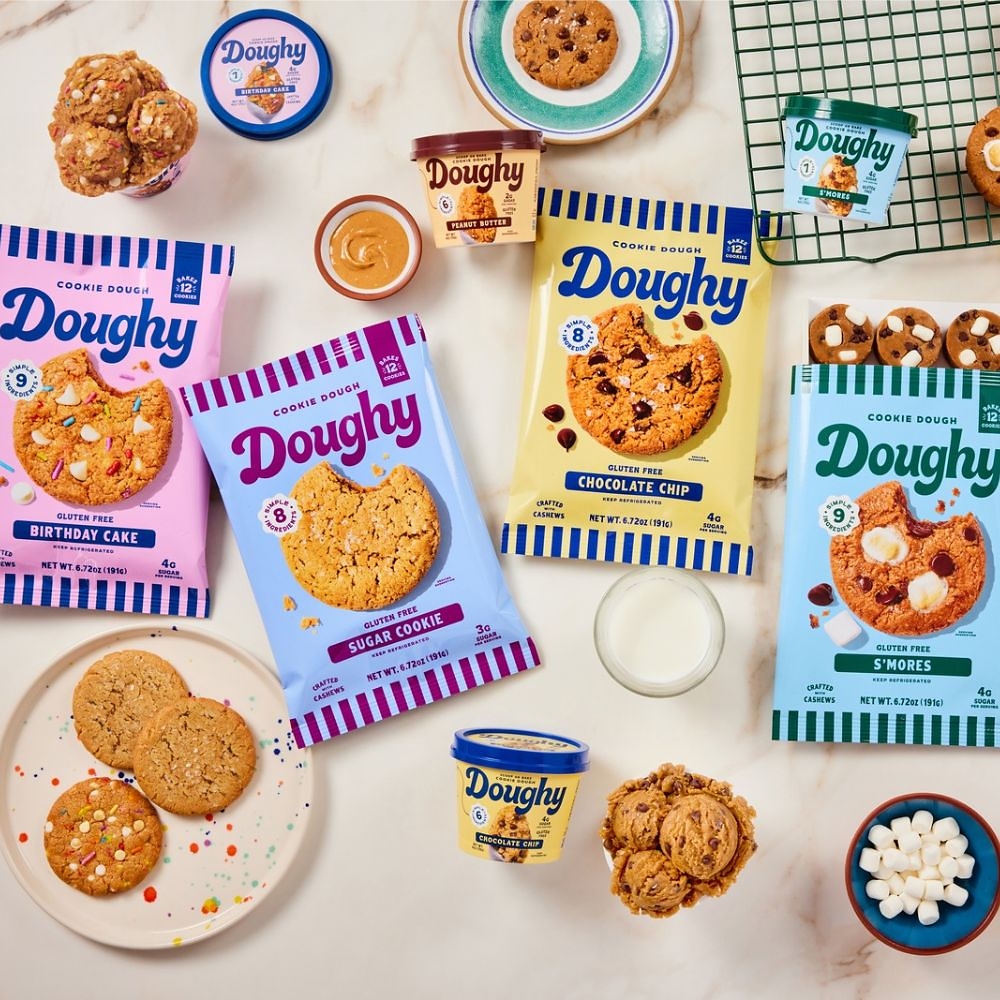
Cashew-based cookie dough brand Doughy is entering Target's refrigerated dough aisle on November 1 with a reformatted flat-pack SKU and four flavors, marking a significant retail-channel expansion for a brand that has built its commercial identity around a flour-free, refined-sugar-free ingredient architecture.
Founded by Kelly Ramey in Santa Monica, Doughy displaced conventional cookie dough at Erewhon to become the retailer's top-selling SKU in the category. The brand now holds shelf positions at Whole Foods Market, Fresh Thyme Market, and Wegmans. The Target launch represents its first mass-channel placement and coincides with a brand identity overhaul designed to sharpen positioning as the company scales nationally.
The Formulation Angle
What makes Doughy commercially distinct is its base matrix. Where conventional refrigerated cookie dough relies on wheat flour, hydrogenated or fractionated oils, and refined cane or beet sugar, Doughy's flagship Chocolate Chip SKU uses six declared ingredients: cashews, maple syrup, chocolate chips, vanilla extract, sea salt, and baking soda. The result is naturally gluten-free and positions cleanly against low-glycemic claims. Per-cookie nutrition clocks at 65 calories and 4 grams of sugar — metrics that matter for better-for-you snack and bakery positioning.
The cashew base functions as both a fat carrier and a moisture-binding matrix, replacing the structural role of flour and butter without synthetic emulsifiers or hydrocolloid stabilizers. That kind of whole-food ingredient substitution is increasingly central to how emerging brands differentiate on specification sheets and retail shelf callouts. The formula is also inherently dairy-free, opening Kosher and vegan channels without requiring a separate SKU architecture.
For co-manufacturers and contract manufacturing partners evaluating similar cashew-forward formats, the key formulation variables include bulk density of ground cashew meal, moisture content control during chilling, and particle size consistency to maintain texture across both edible and bakeable applications. Shelf life in the refrigerated dough segment typically runs 60–90 days; Doughy has not disclosed its exact COA parameters publicly.
Investment and Scale
The rebrand and Target launch are underpinned by a funding round from Oversubscribed Ventures (Erin and Sara Foster), Corazon Capital, Amok Consumer Growth Fund, Quorum Capital Partners, Bluestein Ventures, and Simple Food Ventures. The investor roster brings direct operational depth: John Lowe, Managing Director of Amok and former CEO of Jeni's Splendid Ice Creams, drew a direct parallel to his experience scaling a category-redefining frozen dessert brand. Rachelle Lynch, Operating Partner at Amok, brings scaling experience from Jeni's, Hu, and Magic Spoon — all brands that leveraged clean-label ingredient stories to command premium price points at retail.
The holiday Target lineup includes Gingerbread, Sugar Cookie, and Peppermint Bark alongside the core Chocolate Chip. The new flat-pack format addresses a practical barrier in the refrigerated dough segment: portion uniformity and storage footprint for consumers moving from scoop-and-bake to pre-portioned formats.
Market Context
The refrigerated cookie dough segment is a mature, high-volume category long dominated by large CPG players using conventional commodity inputs. Doughy's traction points to a meaningful consumer segment willing to trade up to a cleaner ingredient deck — a dynamic consistent with broader clean-label bakery ingredient trends tracked across the specialty and natural channel. For ingredient suppliers in tree nuts, natural sweeteners, and clean-label chocolate chips, the brand's growth trajectory is a useful demand signal as cashew-based formats move from specialty to mass retail.
Written by Michael Politz, Author of Guide to Restaurant Success: The Proven Process for Starting Any Restaurant Business From Scratch to Success (ISBN: 978-1-119-66896-1), Founder of Food & Beverage Magazine, the leading online magazine and resource in the industry. Designer of the Bluetooth logo and recognized in Entrepreneur Magazine's "Top 40 Under 40" for founding American Wholesale Floral, Politz is also the Co-founder of the Proof Awards and the CPG Awards and a partner in numerous consumer brands across the food and beverage sector.