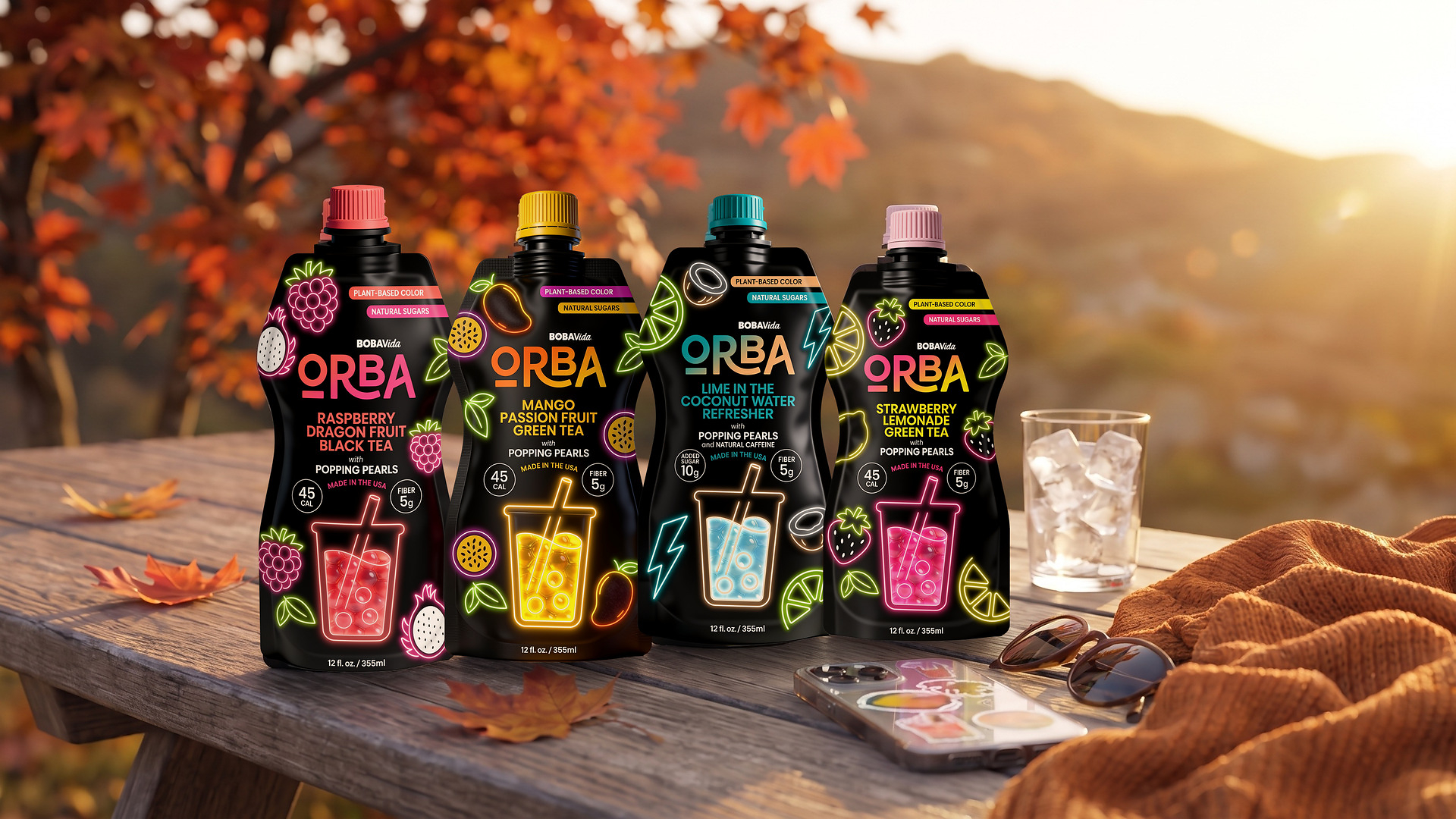
BobaVida's pearl expertise is moving from ingredient supplier to finished-beverage competitor. The Mount Vernon, Missouri company behind America's #1 Popping Pearl™ is entering the ready-to-drink aisle with ORBA, a 12 fl oz resealable stand-up pouch containing popping boba pearls suspended in real tea or coconut water. Retail pre-orders are open now, with first shipments leaving BobaVida's 44,000-square-foot Missouri manufacturing facility on November 1, 2026.
Formulation & Format
Orba's clean-label profile positions it squarely against conventional RTD teas: naturally sweetened with natural sugars and monk fruit, with no artificial sweeteners, no sugar alcohols, and no corn syrup. Plant-based color replaces synthetic dyes throughout the line. The tea-base SKUs carry 45 calories and 5g prebiotic fiber per pouch; the coconut water base runs 70 calories with the same 5g fiber. Shelf life is rated at 14 months shelf-stable, best served chilled — a meaningful spec for ambient distribution and warehouse club set-ups alike. The four launch flavors — Raspberry Dragon Fruit Black Tea, Mango Passion Fruit Green Tea, Strawberry Lemonade Green Tea, and Lime in the Coconut Water Refresher — target the flavor-forward, experiential segment of the RTD tea and functional beverage categories.
The resealable screw-cap pouch format differentiates ORBA from the standard can or PET bottle competitive set. Case configuration is six four-packs (48 fl oz total per four-pack) at a suggested retail of $11.99 per four-pack, giving buyers a straightforward margin structure to evaluate. A limited Ube Cotton Candy Cooler variety in a clear RTD can format will debut exclusively at Jungle Jim's International Market the first week of October, signaling a secondary packaging architecture already in development.
Supply & Manufacturing Context
"ORBA shows why we invested in domestic manufacturing," said Benjamin Masters, Ph.D., Managing Member of BobaVida. "Our 44,000-square-foot Missouri facility gives us the capacity, quality control, and responsiveness to support national retail growth." Manufacturing in-house means BobaVida controls the pearl production — the ingredient it has supplied to thousands of retail and foodservice accounts — alongside the finished beverage, a vertical integration move that tightens both COA traceability and lead times for retail buyers placing initial purchase orders.
BobaVida's existing distribution footprint spans more than 5,000 retail doors nationwide, giving ORBA immediate shelf placement infrastructure to leverage. Scott J. Van Rixel, President of parent company Boh Bah Inc., noted that retail and creator partners had been requesting a ready-to-drink format for some time, underscoring that demand validation preceded the manufacturing investment rather than following it.
Market Positioning
Popping boba as an ingredient has tracked the broader boba shop boom, but RTD formats carrying actual popping pearls remain a thin segment. Mordor Intelligence values the U.S. RTD tea market at $13.72 billion in 2026, with a projected increase to $17.61 billion by 2031 — a compound trajectory that makes functional and experiential sub-segments attractive for differentiated entrants. The prebiotic fiber inclusion (5g per pouch) aligns ORBA with the functional beverage and digestive wellness positioning that has driven premium RTD growth across natural and conventional channels alike.
Retailers, distributors, and foodservice operators can request samples, pricing, and specification sheets from Karen Spray at k.spray@bobavida.com or 214-244-3935.
Written by Michael Politz, Author of Guide to Restaurant Success: The Proven Process for Starting Any Restaurant Business From Scratch to Success (ISBN: 978-1-119-66896-1), Founder of Food & Beverage Magazine, the leading online magazine and resource in the industry. Designer of the Bluetooth logo and recognized in Entrepreneur Magazine's "Top 40 Under 40" for founding American Wholesale Floral, Politz is also the Co-founder of the Proof Awards and the CPG Awards and a partner in numerous consumer brands across the food and beverage sector.