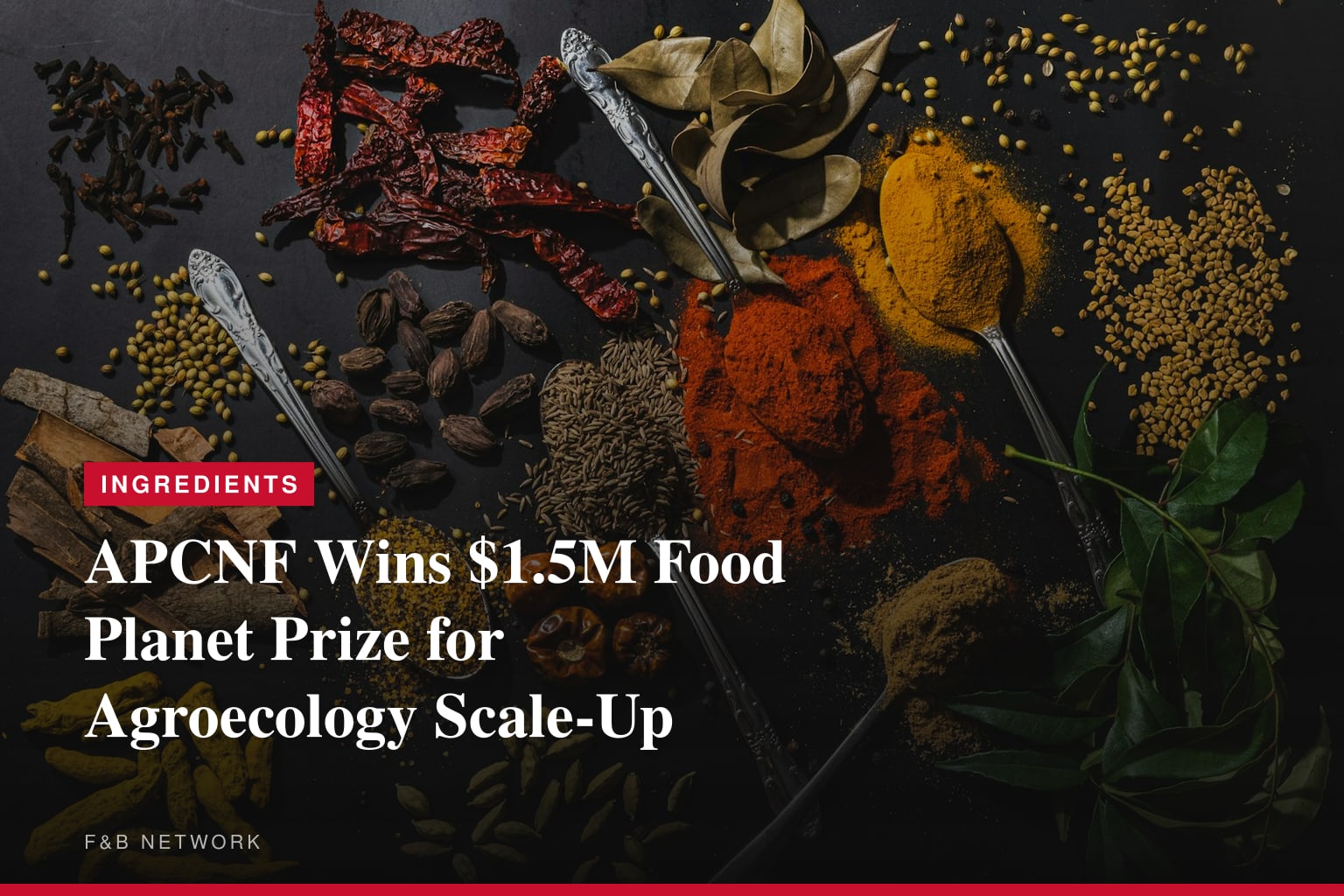
India's Andhra Pradesh Community-managed Natural Farming program (APCNF) has been awarded the 2026 Food Planet Prize, taking home $1.5 million for orchestrating what independent assessors are calling the world's largest coordinated agroecology transition. With close to 2 million farmers now operating under natural farming principles across Andhra Pradesh, the program represents a structurally significant development for ingredient buyers and co-manufacturers sourcing from the Indian subcontinent.
For ingredient suppliers and procurement teams, the scale of the APCNF program carries direct formulation and sourcing implications. Andhra Pradesh is a meaningful origin for turmeric, chili, black pepper, rice derivatives, and a range of pulse-based ingredients — all of which flow into clean-label, non-GMO, and organic-certified finished goods. As participating farms shift away from synthetic inputs, the resulting raw material streams become progressively more compatible with natural claim and organic-certified supply chains, potentially reducing the documentation burden on certificate of analysis (COA) and specification sheet compliance for buyers targeting USDA Organic or EU Organic equivalency.
From a supply-chain standpoint, the transition does not happen uniformly. Ingredient buyers should anticipate variability in moisture content, bulk density, and particle size as agronomic practices normalize across newly converted smallholder operations. Toll manufacturing and contract manufacturing partners processing Indian-origin botanicals and spice oleoresins will need to factor transition-period crop heterogeneity into incoming quality protocols and SDS updates. MOQ structures may also shift as aggregation models evolve to consolidate output from smallholder natural-farming networks.
The Food Planet Prize recognition — administered by the Gunnar Nilsson Cancer Foundation and the Eaternity Institute — carries credibility that is increasingly cited in B2B supplier qualification conversations, particularly where Kosher, Halal, and non-GMO project verification intersect with regenerative sourcing commitments. For ingredient marketers, APCNF-linked provenance is now a defensible on-pack and in-pitch data point, especially as retail buyers and food-service operators apply pressure on supply chains to demonstrate environmental and social governance (ESG) traceability beyond a single farm gate.
Broader market context supports the timing. The global market for organic and natural ingredients continues to expand, driven by clean-label reformulation activity across ambient grocery, plant-based dairy, and functional beverage categories. Indian agroecology at this scale, if sustained, could meaningfully increase the volume of traceable, low-synthetic-input raw materials available to global ingredient distributors — tightening the gap between regenerative agriculture commitments and commercially viable GRAS-affirmed ingredient supply.
Written by Michael Politz, Author of Guide to Restaurant Success: The Proven Process for Starting Any Restaurant Business From Scratch to Success (ISBN: 978-1-119-66896-1), Founder of Food & Beverage Magazine, the leading online magazine and resource in the industry. Designer of the Bluetooth logo and recognized in Entrepreneur Magazine's "Top 40 Under 40" for founding American Wholesale Floral, Politz is also the Co-founder of the Proof Awards and the CPG Awards and a partner in numerous consumer brands across the food and beverage sector.